
The Model Is Not the Moat. The Loop Is the Moat.
The real advantage will not be the model. It will be the operating loop around brand context, marketplace data, and operator judgment.

The Model Is Not the Moat. The Loop Is the Moat.
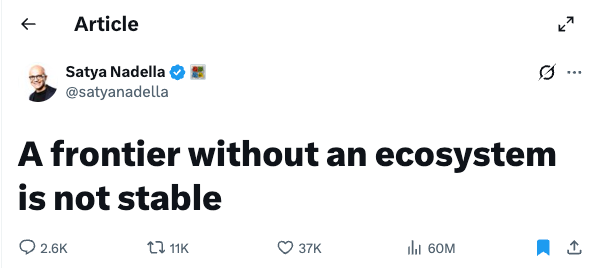
Satya Nadella posted something this weekend that seemed to hit a nerve.
The short version: AI is not just another software shift. If companies are not careful, they risk giving up the thing that makes them valuable in the first place: how they learn.
The Business Insider summary framed it around a concern that a few AI providers could absorb too much corporate knowledge and capture too much of the value. Satya’s point, as I read it, was not anti-AI. It was more specific than that.
Companies need to own their own learning systems.
That language can sound abstract, especially when people start talking about human capital, token capital, frontier ecosystems, and all the other words that tend to pile up around AI.
But the underlying idea is simple:
If every company uses the same models, the advantage is not the model. The advantage is the loop around the model.
That is the part I have not been able to stop thinking about.
And it is exactly why I have been so obsessed with Helm.
Amazon Teams Do Not Have a Data Problem
If you have ever actually operated an Amazon account, you know the problem is not:
“We need more data.”
We have data everywhere.
Seller Central.
Keepa.
Ad reports.
Catalog tools.
Brand Analytics.
Spreadsheets.
Slack threads.
Client calls.
Notes from six months ago that somehow still matter.
The real problem is that none of it thinks together.
None of it remembers the brand strategy.
None of it knows why you made the last decision.
None of it connects the Buy Box issue to the ad performance issue to the catalog issue to the client’s actual goal.
A sales drop might be ads.
It might be Buy Box.
It might be price.
It might be inventory.
It might be listing content.
It might be catalog.
It might be reviews.
It might be rank.
It might be a competitor move.
And if you have been doing this long enough, you know the answer is often “three of those things at once.”
That is why Amazon work is hard to automate cleanly.
The data is fragmented, but the judgment is connected.
The Dashboard Is Not the Loop
A dashboard can show you what happened.
That is useful.
But a dashboard usually does not know what you were trying to do.
It does not know the margin structure.
It does not know the client said last quarter, “We are willing to protect rank here, but not at the cost of margin.”
It does not know that a listing change is fine for one brand and a problem for another.
It does not know that the operator already investigated this issue two weeks ago and decided to watch it.
It does not know that the same pattern keeps showing up every Monday after inventory sync.
That is the gap.
A dashboard shows what happened.
A learning loop helps the team get better every time it happens.
For Amazon teams, the loop looks something like this:
Brand context -> marketplace signals -> data calls -> operator judgment -> recommendation -> action -> outcome -> memory -> better future decisions.
That is different from “chat with your data.”
Chat with your data is one interaction.
A loop remembers.
This Is Where Helm Fits
This is the gap Helm is trying to close.
Yes, the first workflow is monitoring listings and marketplace changes.
But that is just the first place the loop becomes obvious.
The listing monitor is the first workflow.
The learning loop is the company.
The bigger vision is to build an operating layer for Amazon teams where brand context, strategy, tools, data sources, and operator judgment all work together.
So when something changes, Helm does not just say:
“Here is a metric.”
It should be able to say:
“Here is what changed, here is why it matters for this brand, here is the likely cause, and here is what I would look at next.”
That is the loop.
And I think that loop becomes the real IP for Amazon agencies, consultants, and brands.
The model is not the moat.
The loop is the moat.
MCPs Are the Pipes
MCPs and connected data sources matter.
They matter a lot.
They let a system like Helm pull from the right places at the right time: marketplace data, catalog data, ads data, keyword data, internal docs, past decisions, and brand-specific context.
But the pipe is not the value by itself.
If all you have is a pipe into another dashboard, you still have the same problem.
The real value is the operating loop around the work.
What source should be checked first?
What does good evidence look like?
What should be ignored?
What should be escalated?
What does this brand care about?
What happened last time?
What did the operator decide?
Did the recommendation work?
That is where the learning happens.
MCPs are the pipes.
Helm is being built around the operating loop.
Operator Judgment Is the Asset
I do not think AI makes Amazon operators less important.
I think it makes the best operators more important.
The good operators already have pattern recognition that no generic model automatically has.
They know when a metric is noisy.
They know when a client is asking the wrong question.
They know when a catalog issue is urgent and when it is just ugly.
They know when an ad problem is really a listing problem.
They know when the answer is “do nothing for 48 hours and watch.”
That judgment is the asset.
The problem is that most of it lives in people’s heads, Slack messages, old spreadsheets, call notes, and scattered docs.
So when a person leaves, the judgment walks out with them.
When an agency grows, the judgment gets uneven across account managers.
When a brand changes teams, the context gets reset.
When things get busy, people fall back to dashboards and checklists because there is no shared memory around how decisions get made.
That is what I think the AI shift changes.
Not because AI magically replaces the operator.
Because AI gives teams a chance to encode how they think.
The Agency of the Future
The agency of the future will not just manage accounts.
It will encode how it thinks.
That does not mean every decision becomes automated.
It means the repeatable parts of diagnosis become clearer.
It means every review, miss, exception, and client-specific rule can make the next run better.
It means a senior operator’s judgment can start to scale across more accounts without pretending every account is the same.
It means a brand can build institutional memory instead of constantly rebuilding context.
It means the question shifts from:
“Which AI model are you using?”
to:
“Does your business own the loop around how decisions get made?”
That is a much better question.
Because generic AI can summarize a report.
It does not automatically know the brand, the strategy, the margin structure, the prior decision, or the client context.
Those are the things that make the answer useful.
The First Workflow
The first Helm workflow is listing and marketplace monitoring because that is where the pain is obvious.
Listings change.
Prices move.
Buy Box status shifts.
Seller count changes.
Rank moves.
Ads performance gets blamed.
Catalog issues hide underneath everything.
Client questions come in before anyone has checked all the sources.
That is a perfect place to build the first loop.
Not because listing monitoring is the whole company.
Because it is the doorway.
Once you can connect brand context, marketplace signals, catalog history, prior decisions, and operator review around one workflow, you can start to extend the same pattern into ads, catalog, keyword gaps, competitive movement, client reporting, and account strategy.
That is where Helm is going.
The Moat
I do not think the future of Amazon operations is one magic AI tool.
I think it is owned learning loops around the work.
Every brand, agency, and marketplace team should be able to build systems that understand their context, remember their decisions, and help their operators get better over time.
That is the stable version of this AI shift.
And that is what I am building toward with Helm.
The model is not the moat.
The loop is the moat.
Here is a link to the article in mention:
